
RESILIENT AI ADOPTION IN
GREATER MANCHESTER REPORT
The report offers an overview of Manchester’s current AI ecosystem, arguing for a strategic shift in AI policy towards resilient and inclusive adoption approaches, alongside supporting economic growth.
Manchester is home to one of the largest AI ecosystems in the UK. Twice recognised by the SAS AI Cities Index as the most AI-ready city outside of London, the city’s AI economy has experienced rapid growth in recent years, increasing by 25% between 2023 and 2024. Supported by five world-leading universities, significant funding from the UK’s innovation funding agency, and a vibrant business ecosystem, Manchester’s strengths have earned recognition on both the national and international stage.
Despite these successes, prevailing narratives concentrated on the growth of the city’s AI ecosystem could obscure risks around sustainability, equity and inclusion. While the continuing momentum of Manchester’s AI ecosystem has been widely recognised, benefits of this growth are not evenly experienced across the city.
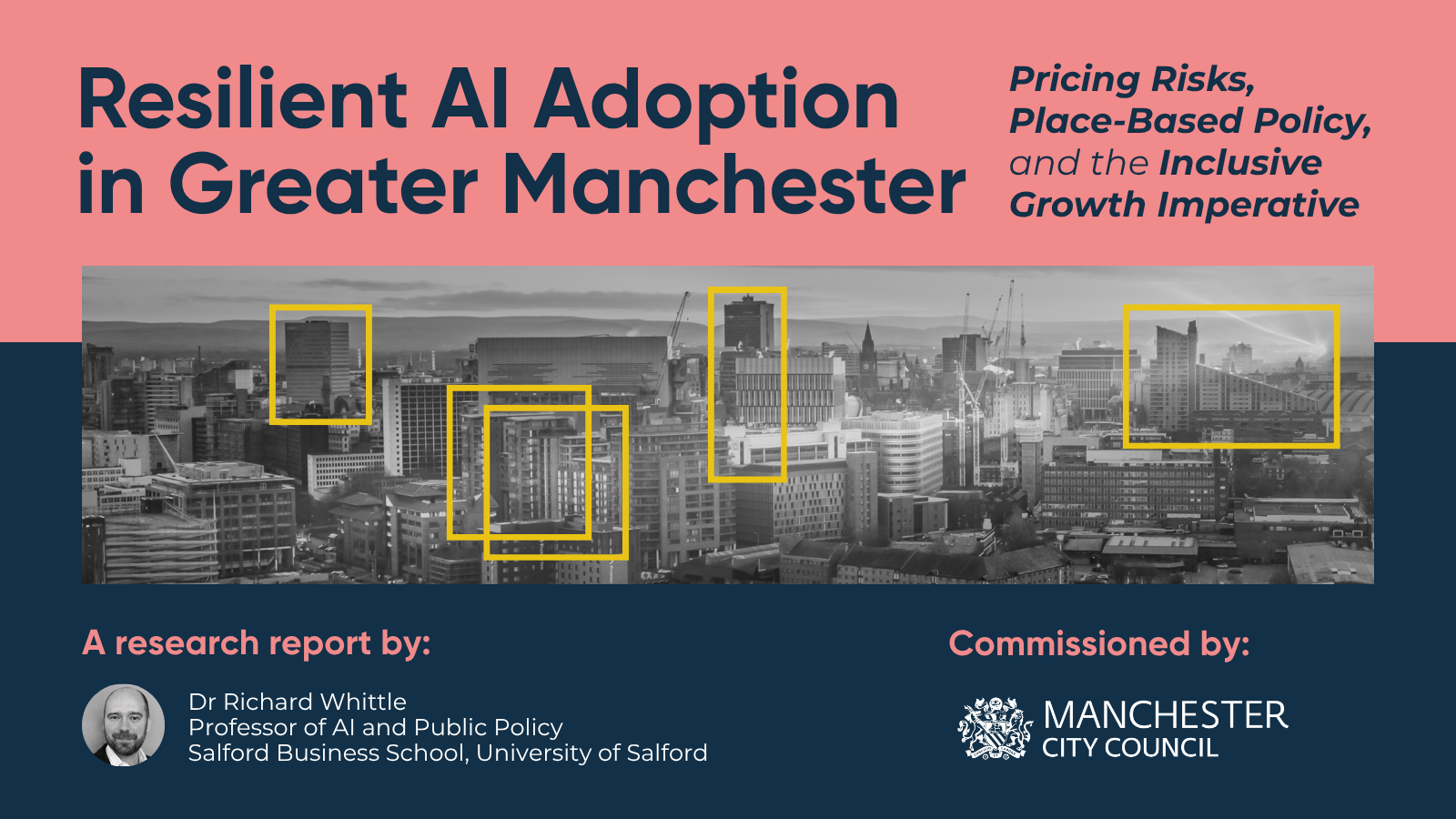
This research report, Resilient AI Adoption in Greater Manchester, was developed by Dr Richard Whittle, Professor of AI and Public Policy at the University of Salford and commissioned by Manchester’s Digital Strategy. The report offers an overview of Manchester’s current AI ecosystem and argues the need for AI policy to improve recognition of resilient and inclusive adoption approaches as well as economic growth.
The report identifies three key, interlocking risks for policy attention:
AI Pricing Shocks
AI vendors can charge prices below cost-plus-margin prices, subsidised by venture capital funding. While low costs aim to encourage rapid adoption and build dependency on AI-enabled services, they cannot be sustained indefinitely. As public institutions become increasingly appealing to AI vendors, it is important that policy frameworks account for cost-recovery pricing changes, and potential impact on services.Place-Based Structural Fragility
AI is not experienced uniformly across Manchester. Common metrics used to evidence the rapid growth of the city’s AI ecosystem obscure variations in exposure and resilience across different parts of the city. Research findings highlight significant vulnerabilities within Manchester’s AI ecosystem, including increasing reliance on subsidised AI pricing, risks of job displacement, and microbusinesses concentrated in areas of high AI exposure that may struggle to compete with AI-enabled competitors.The Distributional Deficit
Despite the rapid growth of Manchester’s AI ecosystem, the city continues to grapple with long-standing challenges around poverty and inequality. Without deliberate policy intervention and active redistribution mechanisms, productivity gains from AI could risk compounding existing inequalities.
Sherelle Fairweather, Digital Strategy Lead at Manchester City Council, said: “Manchester has achieved recognition as an internationally leading AI hub, laying strong foundations to drive both economic and social progress. However, growth alone is not enough. We’re privileged to be working with Dr. Richard Whittle, an expert on the societal impacts of AI and digital transformation, to advocate for equitable, inclusive and responsible approaches to AI. By offering an evidence-informed overview of the strengths, opportunities and risks shaping Manchester’s AI ecosystem, the Resilient AI Adoption in Greater Manchester report reinforces the importance of ensuring that AI policy supports innovation while ensuring the benefits of continued growth are shared equally across the city as whole.”
Professor Katy Mason, Pro-Vice Chancellor at University of Salford said: “Manchester’s strength as an AI city is well established, and this report is an important reminder that resilience, equity and place really matter. Richard Whittle, based at Salford Business School, brings together his expertise in AI and public policy with the Social Innovation Institute as we work in partnership to ensure that AI can support inclusive and socially responsible growth. Richard's evidence and framework is exactly the kind of work needed to help us focus AI innovation and adoption delivers benefits for communities across the city‑region, and so the right kind of economic growth.”
While commissioned by Manchester City Council, the research takes a Greater Manchester perspective to reflect the city‑region’s integrated labour market, academic ecosystem and innovation economy. AI adoption, skills flows and economic impacts operate across borough boundaries, and resilient policy responses must do the same. The work is positioned as part of an evolving evidence base, intended to complement wider policy, academic and industry research and support collective progress on a fast‑moving agenda.
The report highlights:
Key Risks
While Manchester’s AI ecosystem has emerged as the largest outside London, structural risks threaten its sustainability and equity. Addressing these challenges as the ecosystem continues to grow will be essential to ensuring that AI‑led growth is inclusive, fair and sustainable, enabling everyone in Manchester to share in its benefits.Evidence-Informed Analysis
To examine vulnerabilities within Manchester’s AI ecosystem, the report applies several analytical models to sub-regional data - including the Place-Based AI Impact Scale (PBAIIS), AI Occupational Exposure (AIOE), and AI Industry Exposure (AIIE). Through adopting a rigorous, data-driven approach, the report ensures findings, analysis and recommendations are firmly grounded in evidence.Policy Recommendations to Strengthen the Ecosystem
Drawing on findings from research, the report sets out ten strategic recommendations to mitigate key risks within Manchester’s AI ecosystem. Addressed jointly to Manchester City Council, the Greater Manchester Combined Authority, and the region’s universities, the recommendations aim to complement existing AI strategy commitments. Priorities include building resilience against AI pricing shocks; developing place-based evidence to inform AI skills investment and business support; strengthening the social economy; embedding equity-driven funding and procurement; and establishing new frameworks for governance and accountability.