
Connecting Higher Blackley: Building Digital Confidence in the Community
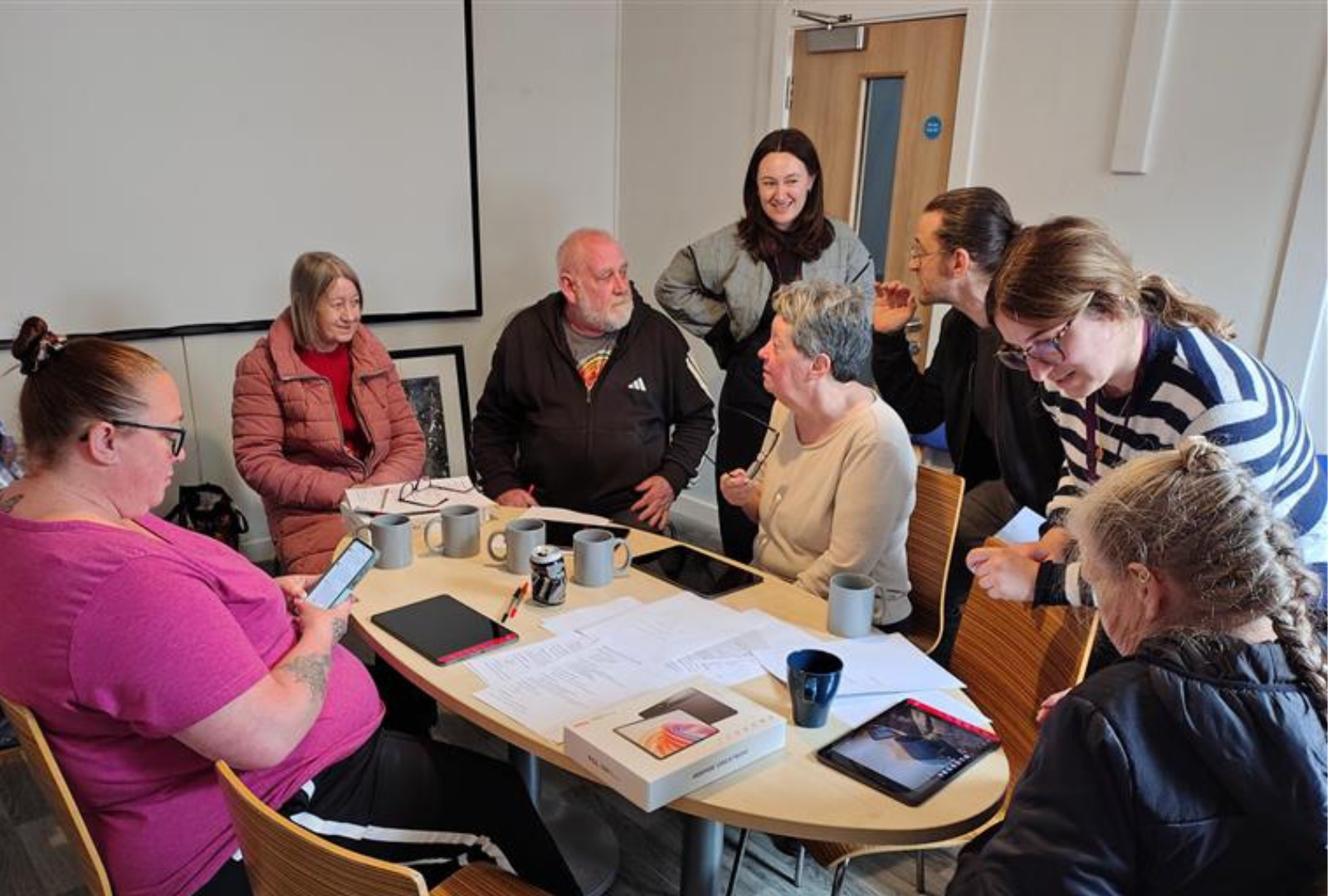
Higher Blackley residents receive tablets as part of the Making Manchester Fairer project
Located on Victoria Avenue in Higher Blackley, the Higher Blackley Community Centre is thriving with activity every day of the week and has served as a trusted hub for local residents for decades.
Manchester City Council’s Digital Inclusion team identified Higher Blackley Community Centre as an ideal space to begin offering digital support. Data from the Digital Exclusion Risk Index shows residents here are more likely to be digitally excluded, and there was a lack of digital provision available in this neighbourhood. This insight marked the beginning of a long-term and supportive partnership between the Digital Inclusion team, Kate, the Centre Manager, and Jacob, the centre’s Digital Inclusion Lead.
Progress began with donated PCs from Manchester City Council (MCC), alongside support from housing provider, Great Places. Working with Community Partnership Manager, Peter Crean, Great Places unlocked £1000 social value funding from Casey’s, which enabled the centre to establish a mini-IT suite.
Peter explains:
'It’s been great working with the council’s digital inclusion team to establish a new partnership with Higher Blackley Community Centre. With Great Places building new homes in the area, it was a perfect opportunity to direct social value funding towards a new IT suite and support the community.'
Building on this foundation, the centre secured a Digital Inclusion grant. This supported the delivery of regular IT sessions, the setup and running of a National Databank, which offers free sims to residents in need, as well as promoting support with the NHS App.
These IT sessions now take place every Friday from 9am–12pm, where Jacob is on hand with a brew and his cheerful demeanour, supporting service users and centre volunteers on their digital journeys. A key factor in the success of these sessions has been Jacob’s commitment to digital inclusion. As he explains:
“I assure the attendee, first and foremost, that They Are Not Alone. Many of the platforms, websites, apps, devices, services that attendees must access are not easy to use or intuitive, often instructions are opaque, vague or contradictory.”
Attendees are supported to find solutions to a wide range of challenges. Most commonly, residents seek help with housing, benefits, the NHS, or employment. In many cases, they leave with new skills, techniques, or tools, enabling them to tackle not only the issue they arrived with but similar challenges in the future.
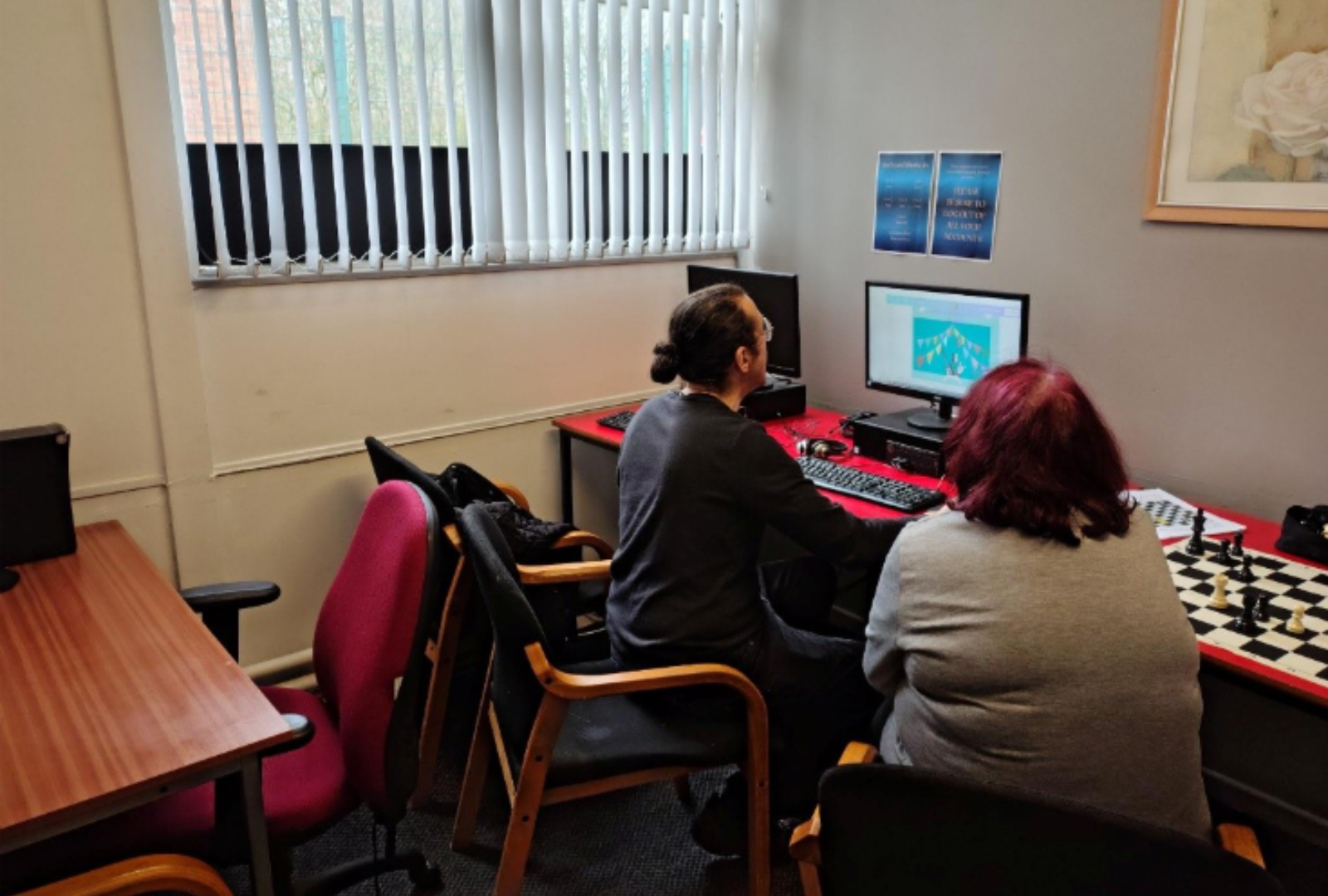
Jacob, Digital Inclusion Lead, supporting local resident with digital
Alongside these successful sessions, the centre’s role as a National Databank has also had a significant impact. Jacob shares:
“A service user came to a session because they had heard about the National Databank. They did have a mobile phone and were using it intermittently, when they had WiFi access, to communicate with friends and family. As an older person working in poverty, they were a perfect candidate to receive a free sim card from the databank… I’ve not long ago received news that they are organising their appointments with their GP for themselves over the phone and using the NHS app.”
The partnership with Higher Blackley Community Centre has further blossomed in the Spring. Through Anti-Poverty Strategy funding (Making Manchester Fairer), 12 new tablets and 3 data SIM cards were gifted to older centre users, who the staff had identified as without access to a device, and in some cases without internet at home.
Digital Inclusion team members Emily, Georgie, and Bua supported residents to set up their devices during a session in May, offering help with passwords, download apps, and customising accessibility settings to meet their needs. Combined with the ongoing, wraparound support from Jacob’s weekly sessions, residents are gaining confidence and independence online.
Reflecting on the broader impact, Jacob explains:
“It has been eye opening just how big the impact on people the digital inclusion sessions have. The parts of people’s lives that digital inclusion touches are many and ultimately, quite intimate. It has begun to work as an incredible tool for engagement; we begin by supporting a service user with some technical issue and then the user themselves guide us to the pain points in their lives which they feel ready to deal with. This opens up for us options to support users which we would not have discovered so quickly, or even at all.”
The team looks forward to seeing these sessions continue to grow, and to supporting more residents in gaining confidence online.
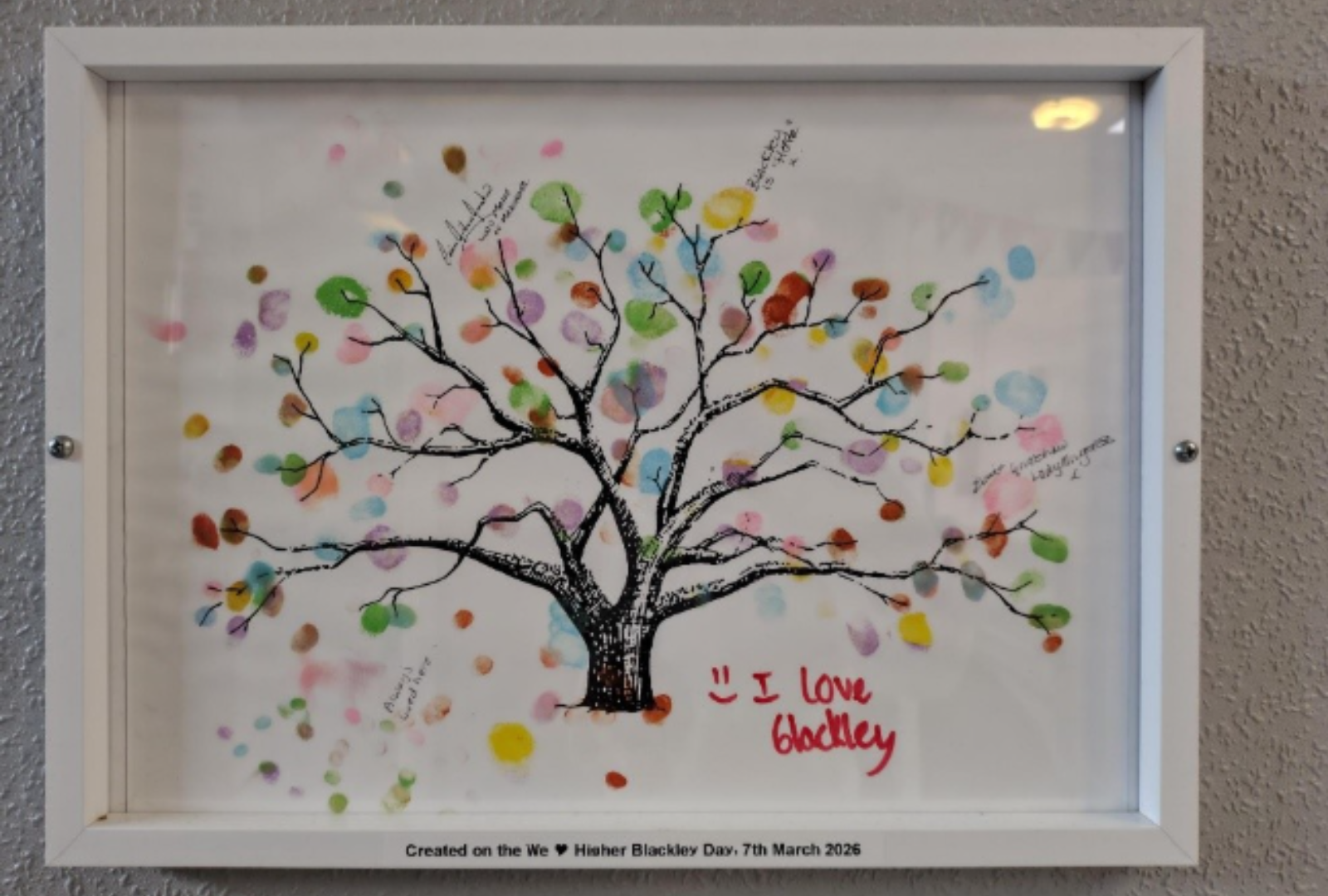
Artwork of a framed fingerprint tree at Higher Blackley Community Centre
Questions? Get in touch with our Digital Inclusion team by e-mailing us at digitalinclusion@manchester.gov.uk.